

Geospatial Data Visualization: Transforming Insight Across Public Health, Urban Planning, Environmental Monitoring, and Disaster Response
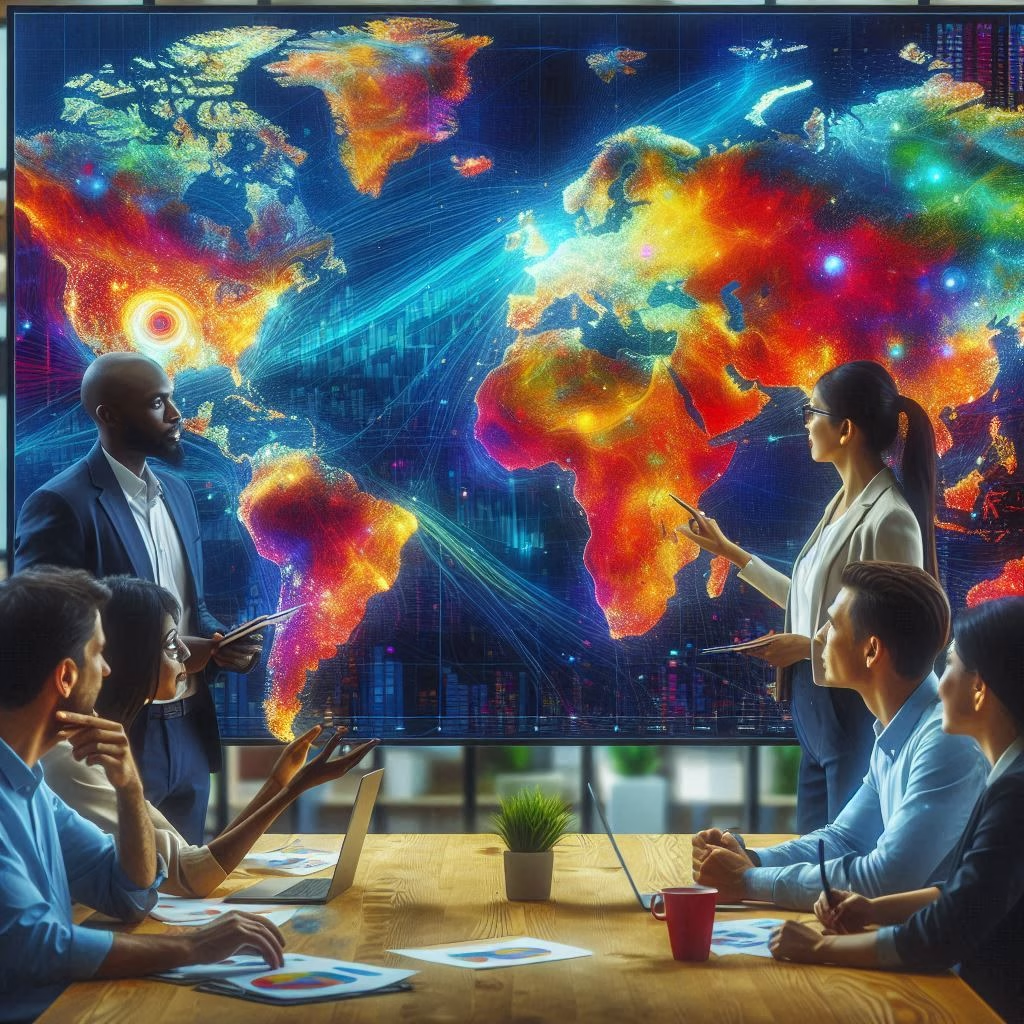
In our data-driven age, spatial context is key to unlocking meaning from the vast datasets that shape society’s most urgent challenges. Geospatial data visualization—the science and art of translating raw location-based data into visual and interactive maps—has evolved as a cornerstone technique, empowering professionals and enthusiasts to analyze, communicate, and act on complex patterns in public health, urban design, environmental management, and disaster resilience. As cities expand, climate risks intensify, and expectations for evidence-based decision-making grow, mastering the tools and techniques of geospatial visualization is no longer optional—it is essential.
Geospatial visualizations do more than make data “look good.” They expose otherwise hidden spatial relationships, time trends, and dependencies crucial for strategic allocation of resources, for public engagement, and for rapid response to emergencies. From mapping COVID-19 outbreaks to planning green city infrastructure, geospatial visualization delivers actionable intelligence with clarity and immediacy.
In this deep dive, we will explore how cutting-edge geospatial visualization is transforming applications in public health, urban planning, environmental monitoring, and disaster response—with concrete examples from the United States and Canada. We will survey leading platforms—commercial and open-source—and highlight emerging trends like real-time dashboards, AI-powered analytics, and citizen-science mapping. The report culminates in an actionable guide for professionals and enthusiasts seeking to leverage these capabilities for impact.

The Fundamentals of Geospatial Data Visualization
Geospatial data visualization involves the process of rendering spatial datasets—anything linked to a geographic location—into visual representations such as maps, dashboards, or interactive tools that shed light on spatial patterns, relationships, and trends. Unlike static tables or charts, well-crafted geospatial visualizations deliver instant comprehension of “where” events happen and how location influences phenomena.
Key Visualization Techniques include:
- Choropleth Maps: Regions shaded by value, ideal for comparing rates of disease, crime, or environmental risk.
- Heatmaps: Gradient color overlays reveal ‘hot spots’ of density or intensity.
- Point, Proportional Symbol, and Cluster Maps: Show discrete event locations or aggregate points at different zoom levels.
- Cartograms and Hexbin Maps: Modify area or group points for emphasis based on variable values.
- Time-series and Animated Maps: Reveal changes and movements over time.
- 3D and Augmented Reality Models: Simulate urban environments and potential developments.
A thoughtful choice of visualization conveys critical information to non-technical stakeholders quickly—making it indispensable for policy, public health campaigns, urban project buy-in, environmental advocacy, and crisis management.
Geospatial Data Visualization in Public Health
Mapping Health to Drive Better Outcomes
The public health sector has seen a dramatic transformation through geospatial visualization. From the historic mapping of cholera cases by John Snow in 1854 to today’s pandemic dashboards, location-based data analysis has revealed the spatial spread of diseases, health disparities, and the targeting of interventions.
Foundational Use Cases:
- Disease Surveillance and Outbreak Tracking: Visualizing confirmed disease cases with point or choropleth maps uncovers clusters and guides containment (e.g., COVID-19 dashboards).
- Resource Planning: Mapping the locations of hospitals, clinics, and testing centers relative to population needs.
- Environmental Health Analysis: Linking air, water, and soil quality data to health outcomes with spatial overlays.
- Health Equity and Disparities: Identifying regions with elevated health risks and correlating with socioeconomic or demographic factors.
- Community Engagement: Using story maps, dashboards, and crowdsourced data collection to involve the public in health campaigns.
Case Study: Canada
Esri Canada provides several geospatial data products supporting Canadian health analysis:
- ArcGIS Living Atlas: The most comprehensive global database of geographic information, with hundreds of health-related web maps and data layers, many focused on Canada. Examples include the Open Database of Healthcare Facilities (ODHF), which aggregates authoritative facility data from health authorities and governments across Canada.
- Community Map of Canada: Seamlessly maintained base map, updated daily, underpins reliable health data overlays—from pandemic resource deployment to long-term planning.
- Environics Analytics: Adds health-specific datasets like the Canadian Community Health Survey and Frailty Index, enabling hyperlocal analysis of community health and vulnerabilities.
US Highlights
- CDC’s PLACES Interactive Map: Offers at-a-glance and granular mapping of health outcomes, behaviors, and interventions down to the ZIP code level. Health professionals use this to allocate resources and identify needs.
- County Health Rankings in ArcGIS Living Atlas: Provides interactive visualization of health outcomes and health factors for every US county, allowing for comparative studies and targeted health initiatives.
- Johns Hopkins COVID-19 Dashboard: Set a new standard for global disease tracking through real-time, interactive mapping of cases, trends, and public health measures, widely used by the public and policymakers.
Transformative Impact
Geospatial visualization in health is not confined to high-level mapping. By integrating demographic, environmental, and epidemiological data, professionals can spot local ‘hot spots’, model risk, and communicate complex findings effectively. For example, layering chronic disease prevalence over environmental risk data can reveal previously overlooked causal relationships, enabling targeted outreach and resource allocation.
Moreover, emerging tools incorporate AI and machine learning to automate pattern detection, improve disease prediction, and create interactive dashboards where users can explore health disparities and resource access in real time.
Geospatial Data Visualization in Urban Planning
Building Smarter, More Equitable Cities
Urban planners have always relied on spatial information, but today’s geospatial visualization tools provide unprecedented power to integrate, analyze, and communicate urban complexity. Zoning, transportation, equity, green infrastructure, and climate resilience are all fundamentally spatial—and geospatial visualizations make complexity manageable and actionable.
Core Applications:
- Zoning and Land Use Scenarios: Interactive and 3D maps allow simulation of development impacts, optimizing density, community space, and resilience.
- Transportation Analytics: Visualizing traffic, transit, and mobility flows uncovers bottlenecks, informs new routes, and tracks the impacts of interventions.
- Climate and Risk Assessment: Maps of flood, heat, or air quality risks inform adaptation strategies, tree planting priorities, and public safety measures.
- Public Engagement: Story maps and participatory platforms allow residents to co-design neighborhoods, submit feedback, and visualize changes.
- Community Health and Equity: Heat-island maps, walkability studies, and amenity access surfaces highlight underserved districts and support policy for inclusion.
US Examples
- Seattle Green Stormwater Infrastructure Map: Integrates data from multiple municipal agencies to visualize green infrastructure across the city, supporting flood reduction and environmental sustainability goals.
- Boston Heat Mapping Initiative: High-resolution thermal mapping, combined with demographic data, steered interventions like green roofs and cooling spaces, prioritizing vulnerable populations.
- Chicago, Calgary, Montreal Digital Twins: Real-time urban models ingest traffic, energy, and pedestrian counts for scenario simulation and infrastructure optimization.
Canada
- Toronto’s Open Data and Land Use Visualization: Extensive open mapping of zoning, land use, transit, and urban health profiles guide everything from new developments to infrastructure upgrades—integrated with platforms like QGIS and ArcGIS.
- Vancouver VanMap: Offers interactive access to layers on property, zoning, and public infrastructure, critical for holistic planning and public transparency.
Emerging Techniques
- 3D and Augmented Reality Visualization: Urban “digital twins”—virtual replicas of neighborhoods or city cores—allow planners and citizens to simulate new buildings, analyze shadow/sightline impacts, and inform regulatory decisions, often viewed with AR headsets.
- Participatory GIS: Community members contribute via mobile apps or web platforms, mapping amenities, hazards, or accessibility challenges (“crowdsourcing for urban equity”).
- Real-Time Dashboards and IoT Integration: Noise, air quality, and mobility are now tracked live, visualized in public and agency dashboards to inform both daily operations and long-term planning.
Geospatial Data Visualization in Environmental Monitoring
Safeguarding Natural Resources with Spatial Intelligence
Environmental monitoring depends on integrating data from the sky (satellites), ground (sensors), and field surveys to provide spatially and temporally consistent insights into ecological threats, changes, and interventions. Geospatial visualization turns this data bounty into strategic intelligence.
Core Applications:
- Water Quality and Aquatic Monitoring: Mapping nutrient runoff causes, algal blooms, and pollutant plumes in lakes and rivers for targeted advisories and cleanups.
- Air Quality Dashboards: Interpolated mapping from sensor networks to reveal pollution hot spots and guide health warnings, with examples from Los Angeles and Toronto.
- Wildfire and Forest Health: Visualizing satellite, LiDAR, and field data to spot risks from pests, dryness, and fire potential; mapping active fire lines for responder coordination.
- Urban Heat and Green Infrastructure: Remote sensing and microclimate mapping pinpoint urban heat islands and direct tree-planting or cooling interventions.
- Biodiversity and Habitat Change: Mapping of species, habitat loss, and tracking of invasive species to inform conservation action.
- Coastal Vulnerability: Monitoring sea-level rise, erosion, and flood risk for adaptation planning in both urban and rural communities.
US and Canada in Action
- Great Lakes Algal Bloom Forecast: Combines satellite chlorophyll data with watershed and weather models, visualized in dashboards for Michigan and Ontario agencies, enabling anticipatory warnings.
- Puget Sound Oil Spill Response: GIS dashboards with ship tracking and current forecasts optimize containment and cleanup.
- Nova Scotia Coastal Erosion: Drone-based photogrammetry delivers high-resolution maps for site-specific adaptation decisions.
- Montreal and Boston Urban Heat Mapping: Satellite-enabled mapping of neighborhood-level temperature supports resilience planning and equity-focused interventions.
Visualization Tools in the Environmental Sector
- ArcGIS Online and Living Atlas: Ready-made basemaps, satellite imagery, and analytical tools for environmental data.
- QGIS with Environmental Plugins: Open-source workflows, integrating with SAGA and GRASS for terrain, hydrology, and habitat modeling.
- Google Earth Engine: Cloud-based analysis and visualization of massive time-series satellite datasets, critical for forest monitoring, climate change analysis, and water management.
Crowdsourcing and Citizen Science
The rise of platforms like iNaturalist and story map dashboards enables millions of data points from ordinary citizens—photos, sound recordings, and field observations—feeding into interactive visualizations that expand the reach and granularity of environmental monitoring.
Geospatial Data Visualization in Disaster Response
From Preparedness to Real-Time Action
Disaster response hinges on situational awareness: understanding where people, hazards, resources, and needs intersect—often in rapidly changing conditions. Real-time geospatial visualizations are now integral to every phase of emergency management:
Critical Applications:
- Risk and Hazard Mapping: Identifying flood zones, earthquake faults, hurricane paths, and population vulnerabilities in advance.
- Real-Time Dashboards: Mapping the position of active hazards, resource availability, evacuation routes, and incident status, supporting rapid decision-making and public information.
- Damage Assessment and Recovery: Comparing pre- and post-event imagery to assess destruction, prioritize search and rescue, and guide rebuilds.
- Resource Coordination: Visual dashboards link logistics with the locations of shelters, hospitals, road closures, and critical supply depots.
US Case Example
- FEMA Response Geospatial Office: Captures data from field teams, sensors, and satellites, turns it into decision-ready maps used to characterize disaster impacts, prioritize missions, and expedite recovery grants.
- Missouri Task Force One (MO-TF1): Uses mobile GIS, cloud-based basemaps, and real-time map feeds to coordinate wide-area search and rescue during disasters, integrating with federal and local data pipes.
- Esri Disaster Response Program: Maintains cloud-accessible dashboards, map layers, and live feeds for emergency use across sectors, making field and agency data interoperable and accessible even in low-connectivity scenarios.
Canada
Although much of Canada’s disaster mapping is administered at the provincial level, harmonized federal data layers and open standards mean that inventories of risk, real-time mapping, and damage assessments are increasingly shared across agencies and with the public.
Key Features of Effective Visualization
- Cloud and Edge Integration: Deploys up-to-the-minute maps accessible even in bandwidth-constrained disaster zones.
- Offline Capabilities: Field teams use pre-downloaded maps and data for operations when disconnected, then sync upon reconnection.
- Crowdsourcing Integration: Harnessing reports and geotagged images from affected populations, turning distributed data into situational intelligence.
Impact
These advances mean that today’s emergency response organizations operate from a common operational picture, rapidly iterating plans, allocating resources where the need is greatest, and saving lives. The public also benefits, accessing real-time alerts and situational maps to make informed personal decisions in a crisis.
Essential Tools, Platforms, and Libraries for Geospatial Data Visualization
The range of tools available for geospatial visualization has never been broader or more powerful, spanning commercial industry standards, cutting-edge open source, and new browser-based and AI-powered platforms.
Commercial Geospatial Platforms
- ArcGIS Pro / ArcGIS Online (Esri): The global standard, featuring advanced 2D/3D visualization, seamless data integration, AI-powered analytics, and the Living Atlas of global datasets. Supports robust web dashboards, story maps, and extensive documentation and support.
- Mapbox Studio: Focuses on highly customizable, developer-friendly, interactive maps for web and mobile, featuring advanced 3D effects, vector tile rendering, and seamless integration with Mapbox APIs for real-time data feeds and user interactivity.
- Maptitude: Known for accessible demographic, business, and logistics mapping, often favored by organizations for market and territory planning.
- Bentley, Cadcorp, GeoMedia: High-end platforms focused on enterprise-scale spatial analysis and infrastructure integration.
Open-Source Geospatial Visualization Libraries
- QGIS: Free, mature, and extensible desktop GIS with a vast ecosystem of plugins for mapping, analysis, and dashboard creation. Integrates with GRASS GIS, SAGA, and Python for advanced workflows. Supports commercial-grade cartography, 3D, and web mapping via QGIS Server or direct export.
- GRASS GIS: Strong in environmental modeling and remote sensing, often used in academic and research settings.
- : JavaScript library for interactive, mobile-first, web maps, widely adopted for lightweight web mapping and extensible with custom plugins (including integration with for advanced visual effects).
- : Enables bespoke geospatial techniques, animations, and custom data-driven displays, often paired with Leaflet, Mapbox GL JS, or Observable notebooks for exploratory analysis.
- Google Earth Engine: Cloud-based, massive-scale satellite image analysis, featuring open APIs for advanced environmental and climate applications, and a large array of visualization functions.
AI, Machine Learning, and Next-Gen Visualization
- GeoAI: Integrates AI-driven pattern recognition, feature extraction, and anomaly detection into spatial analysis, using frameworks like TensorFlow, PyTorch, and specialized libraries such as GeoAI-py.
- Python-based Tools (Folium, Plotly, Dash, Shiny): For rapid development of interactive web maps and dashboards, plug directly into familiar research and analytics stacks, as well as spatial libraries (e.g., geopandas, rasterio).
Table: Summarizing Key Geospatial Visualization Tools and Use Cases
| Tool/Platform | Type | Primary Use Cases | Strengths | Limitations |
|---|---|---|---|---|
| ArcGIS Pro/Online | Commercial | Urban planning, health, environmental, and disaster | 2D/3D/4D, analytics, dashboards, global datasets | Expensive, steep learning curve |
| QGIS | Open Source | Urban, environmental, research, education | Free, plugin-rich, integratable | The interface is less intuitive, large dataset is slow |
| Mapbox Studio | Commercial | Custom web/mobile maps, data visualizations | Customizability, 3D/real-time, developer-friendly | Coding skills required for full potential |
| Google Earth Engine | Cloud/Open | Remote sensing, environment, big data analysis | Massive datasets, satellite imagery, scripting | Programming knowledge needed |
| + | Open-source | Web mapping, interactive, user engagement | Lightweight, very flexible, and many tutorials | Requires JS programming, browser-based |
| Tableau | Commercial | Business/use dashboards, public health | Easy dashboards, interactive charts | Limited advanced GIS capability |
| Plotly / Dash / Shiny | Open-source | Custom interactive dashboards, health, urban | Python/R integration, interactivity | Less focus on spatial analysis |
| GRASS GIS | Open Source | Environmental, geoscience, advanced raster | Robust, free, research-grade | UI/learning curve, less business-friendly |
| Atlas (Atlas.co) | Web, SaaS | Collaborative mapping, fast team workflows | Accessible, low-code, collaboration features | Lacks deep analysis capabilities |
| GeoAI (various) | AI/ML | Automation, feature detection, predictive modeling | Integrates ML/DL, state-of-the-art analysis | Technical expertise, evolving field |
Every tool in this table can be the best choice for a particular use case or organization. The right platform depends on budget, technical skill, data requirements, and the need for advanced features like AI integration, scalability, and interactivity.
Emerging Techniques and Future Trends
Real-Time, Scalable, and Collaborative Dashboards
- IoT and Sensor Data Integration: Urban and environmental dashboards now visualize live data from thousands of sensors (air quality, traffic, crowd counts).
- Mobile and Edge-Based Mapping: Field teams can upload data and imagery in disconnected environments, synchronizing later.
- Citizen Science Platforms: Scalable participatory data collection and real-time public engagement.
- Story Maps and Multimedia: Combining maps, narrative, photos, and charts for advocacy and community engagement.
Artificial Intelligence and GeoAI in Geospatial Visualization
- Automated Feature Extraction: AI models (e.g., deep learning) identify land cover, infrastructure, or hazards from satellite imagery, making mapping much faster and less error-prone.
- Predictive and Scenario Analytics: Machine learning algorithms forecast disaster impacts, urban growth, and climate risk, visualized in dashboard ‘what-if’ scenarios.
- Natural Language Interaction: Large language models (like ChatGPT or GeoGPT) increasingly assist non-programmers in querying data and generating maps.
- Explainability and Ethics: New methods enable more interpretable AI-powered spatial analysis, an emerging requirement for policy and safety.
Augmented/Virtual Reality and Advanced 3D Environments
- Digital Twins and 3D City Models: Planners and the public now “walk through” proposed developments using AR, overlaying virtual buildings on real-world views.
- Immersive Visualization for Public Engagement: VR/AR brings future scenarios to life, enabling broader engagement and consensus building.
Cloud-Based, No-Code, and Browser-First Solutions
Browser-based platforms and drag-and-drop dashboards (such as Atlas, Google Earth Engine, and new iterations of QGIS and ArcGIS Online) make advanced geospatial visualization accessible to more users than ever before—not just technical specialists.
Considerations and Best Practices for Geospatial Visualization
- Data Quality and Integration: The impact of spatial visualization rests on accurate, harmonized, and appropriately georeferenced data.
- Map Projection and Scale: Mismatched projections or inappropriate scales can misrepresent spatial relationships.
- Ethics and Privacy: Detailed spatial data can be sensitive; anonymization or aggregation may be required for health, equity, or safety reasons.
- Equity and Accessibility: Visualizations must be interpreted carefully, with attention to historical and systemic biases in data and in map design.
- Public Engagement: In participatory planning or health campaigns, visualizations should invite interaction, feedback, and provide explanatory context (e.g., legends, popups, story elements).
- Scalability and Collaboration: As data and teams grow, cloud-first and collaborative platforms support team workflows and broad dissemination.
Conclusion: Geospatial Data Visualization as a Catalyst for Informed Action
Whether you are a public health analyst mapping vaccine access in rural Canada, an urban planner simulating the environmental impact of a new transit line in Toronto, an environmental advocate tracking wildfire risk in the American West, or a disaster response coordinator deploying mobile search and rescue teams, geospatial data visualization is your pathway from raw data to understanding—and from understanding to impactful action.
The latest advancements—AI-powered analytics, real-time dashboards, cloud-first platforms, and participatory mapping—have lowered the barriers to entry and dramatically expanded what’s possible. Yet, the principles of clarity, accuracy, ethics, and context remain at the heart of effective geospatial storytelling.
The invitation, therefore, is clear: Embrace the tools, master the techniques, and unlock the power of geospatial data visualization to inspire action and deliver solutions to our most pressing societal challenges. The map is not only the territory—it is a window into transformation.


